beerreviewsandmore.com
The Reinheitsgebot: A Law That Shaped Beer, Culture, and Identity
In the spring of 1516, in the duchy of Bavaria, a decree was issued that would ripple far beyond its modest administrative intent. Known today as the Reinheitsgebot, this regulation would go on to become one of the most... Click to Continue Reading.
BEER BLOG
Vince Kozlo
5/6/20265 min read
My post content
The Reinheitsgebot: A Law That Shaped Beer, Culture, and Identity
In the spring of 1516, in the duchy of Bavaria, a decree was issued that would ripple far beyond its modest administrative intent. Known today as the Reinheitsgebot, this regulation would go on to become one of the most enduring and culturally significant food laws in human history. While it began as a regional attempt to regulate brewing practices, it evolved into a symbol of quality, tradition, and even national identity. More than five centuries later, the Reinheitsgebot still influences how beer is made, marketed, and understood—not just in Germany, but across the world.
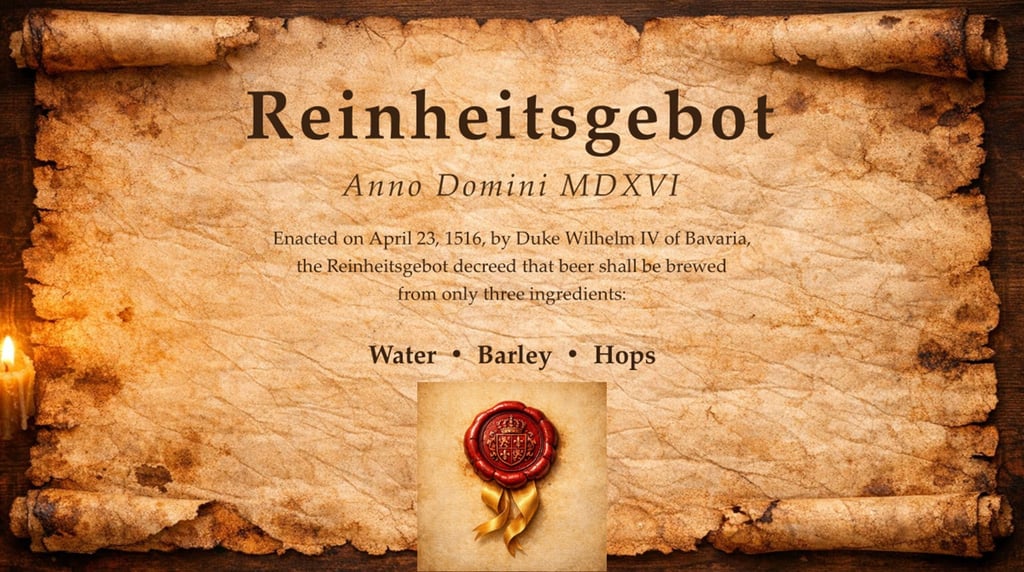
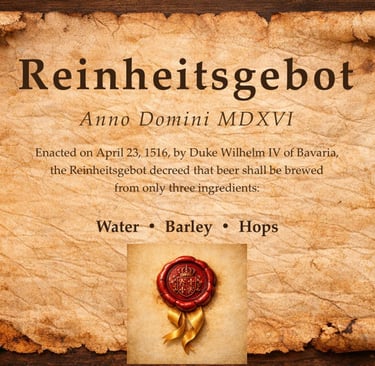
At its core, the original law was deceptively simple. It stated that beer could be made using only three ingredients: water, barley, and hops. Yeast, though essential to fermentation, was not yet understood scientifically and therefore was not included in the original wording. It would not be until centuries later, after advances in microbiology and the work of scientists like Louis Pasteur, that yeast would be formally recognized as a fundamental component of brewing. Yet even without this knowledge, Bavarian brewers were already harnessing fermentation through observation, inherited techniques, and a deep familiarity with their craft.
To understand why such a law emerged, one must consider the economic and social conditions of early 16th-century Europe. Beer was not merely a recreational beverage; it was a dietary staple consumed daily by people of all classes. In many cases, it was safer to drink than water due to the boiling process involved in brewing, which helped eliminate harmful pathogens. In this context, ensuring the safety and consistency of beer was a matter of public welfare. The Reinheitsgebot helped protect consumers from potentially dangerous additives, as brewers at the time sometimes experimented with herbs, roots, and even toxic substances to flavor or preserve their products. Ingredients like henbane or belladonna could produce intoxicating effects, but they also carried serious health risks.
However, public health was only part of the story. The law also served an economic purpose that reflected the realities of agrarian life. By restricting beer production to barley, it preserved wheat and rye—valuable grains needed for bread—for bakers and the general population. This seemingly technical rule reflects a deeper priority: maintaining food security in a society where crop yields could be unpredictable and famine was a constant concern. In this sense, the Reinheitsgebot was as much about controlling resources as it was about regulating quality.
Political authority also played a role. The decree was issued under the rule of William IV, Duke of Bavaria and his brother Ludwig X. By standardizing beer production, they were asserting control over an important economic sector. The law even included price regulations, setting limits on how much beer could be sold for depending on the season. This aspect underscores how closely intertwined governance, commerce, and daily life were in early modern Europe. Beer was not just a commodity—it was part of the social fabric, and controlling it meant exercising influence over the population.
As Bavaria’s influence grew, so too did the reach of its brewing standards. Over time, the principles of the Reinheitsgebot spread beyond regional borders, eventually becoming associated with German brewing as a whole. By the time of the Unification of Germany, the law had taken on new meaning. It was no longer just a practical regulation; it had become a cultural emblem, representing purity, discipline, and craftsmanship—values often associated with German identity. The Reinheitsgebot became a point of pride, distinguishing German beer from that of other nations.
The law’s endurance is particularly striking when viewed in the broader context of scientific and industrial change. The 19th century brought major advances in brewing technology, including refrigeration and improved sanitation. These developments allowed for more consistent production and the rise of lager beer, which would become one of Germany’s most famous exports. At the same time, scientific breakthroughs—especially in microbiology—transformed the understanding of fermentation. Louis Pasteur’s work revealed the role of yeast, turning what had once been a mysterious process into a controlled and predictable one.
Even as brewing became more sophisticated, the Reinheitsgebot remained relevant. It adapted, incorporating new knowledge while preserving its original spirit. Yet this adaptability also exposed tensions. As global trade expanded and cultural exchange increased, new beer styles and ingredients began to circulate. Outside Germany, brewers experimented freely with flavors and techniques, creating a wide range of products that challenged traditional definitions of beer.
This contrast became especially pronounced with the rise of the craft beer movement in the late 20th century. In countries like the United States, brewers embraced creativity, producing beers with ingredients such as fruit, spices, chocolate, and coffee. These innovations appealed to consumers seeking novelty and diversity, but they stood in stark contrast to the restrained approach encouraged by the Reinheitsgebot. For some, the law came to symbolize not just quality, but limitation—a barrier to experimentation in an increasingly globalized market.
Within Germany itself, attitudes began to shift. While many brewers continued to follow the Reinheitsgebot out of tradition and pride, others pushed for greater flexibility. Legal challenges at the European level further complicated matters. Regulations within the European Union emphasized free trade, making it difficult for Germany to enforce strict ingredient rules on imported beers. As a result, the legal status of the Reinheitsgebot evolved. It is no longer applied as an absolute standard across all beers sold in Germany, but it remains a key requirement for those marketed as traditionally German.
Despite these changes, the Reinheitsgebot retains immense symbolic power. It is often described as the world’s oldest food regulation still in use, and it continues to be celebrated as a cornerstone of brewing heritage. Every year on April 23, Germany marks the anniversary of the law with Beer Day, honoring a tradition that has endured for over five centuries. Breweries highlight their adherence to its principles, and consumers are reminded of the values it represents.
The law’s influence extends beyond Germany’s borders. Around the world, breweries invoke the Reinheitsgebot as a mark of authenticity, even when they operate in entirely different regulatory environments. For many consumers, the term has become synonymous with purity and quality, regardless of whether the beer strictly follows its rules. This global recognition speaks to the enduring appeal of the idea behind the law: that simplicity and discipline can produce excellence.
Yet the Reinheitsgebot also invites reflection on the nature of tradition itself. Is it a fixed set of rules, or a living practice that evolves over time? In the world of beer, this question remains open. Some brewers see the law as a foundation—a set of principles that guide their work while leaving room for interpretation. Others view it as a historical artifact, valuable for its legacy but not necessarily suited to modern creativity.
In many ways, the Reinheitsgebot represents a paradox. It is both restrictive and liberating, outdated and timeless, practical and symbolic. It limits ingredients, yet it has inspired centuries of craftsmanship within those constraints. It originated as a local decree, yet it has achieved global recognition. Its endurance suggests that its true power lies not in its specific rules, but in what it represents: a commitment to quality, a respect for tradition, and a belief that even the simplest elements—water, grain, hops, and yeast—can be transformed into something extraordinary.
As the world of brewing continues to evolve, the Reinheitsgebot stands as both a foundation and a point of departure. Some brewers will continue to follow it closely, honoring its legacy with every carefully crafted batch. Others will move beyond it, experimenting with new ingredients and redefining what beer can be. Yet regardless of the path they choose, they remain connected, in some way, to that moment in 1516 when a simple law set the course for centuries of brewing history.