beerreviewsandmore.com
Summer Shandy
By Leinenkugel Brewing Company
DOMESTIC BEER
Vince Kozlo
5/14/20265 min read
The Brewery:
The story of Jacob Leinenkugel Brewing Company is deeply woven into the brewing heritage of the American Midwest. Founded in 1867 in Chippewa Falls, Wisconsin, by German immigrant Jacob Leinenkugel and his business partner John Miller, the brewery emerged during a period when German brewing traditions were transforming American beer culture. Wisconsin’s abundant fresh water and growing German immigrant communities created ideal conditions for lager brewing, and the brewery quickly became a respected regional producer. Over generations, the Leinenkugel family maintained a close connection to the brewery’s identity, emphasizing approachable beers inspired by Bavarian brewing methods while adapting to changing American tastes. Even after the brewery was acquired by Miller Brewing in 1988, the Leinenkugel family remained involved in leadership and brand stewardship, a rare arrangement in the brewing world that helped preserve the brewery’s authenticity and cultural identity.
The brewery’s culture has long emphasized employee loyalty and community connection. Chippewa Falls residents often viewed the brewery not merely as a business, but as a generational employer and civic institution. That relationship has not always been without tension, however. In 2023, brewery workers staged a strike over wage concerns, highlighting the realities of labor relations within large modern brewing operations. Despite such disputes, the company historically cultivated strong ties with employees through long-term employment opportunities, family involvement, and regional pride. The brewery’s public image also reflects its Wisconsin roots through charitable efforts, tourism at the Leinie Lodge, and partnerships tied to outdoor recreation and conservation.
Environmental stewardship has become increasingly important within the brewery’s broader corporate structure. Today, Leinenkugel’s operates under the ownership of Molson Coors Beverage Company, one of the world’s largest brewing corporations. Molson Coors has publicly committed to sustainability initiatives involving water conservation, emissions reduction, recyclable packaging, and responsible sourcing. These initiatives matter greatly for a brewery rooted in Wisconsin, where pristine freshwater resources are central to both brewing and regional identity. The Chippewa Falls brewery itself has emphasized energy efficiency and water management as part of broader corporate environmental goals. The current ownership structure allows Leinenkugel’s to retain its heritage branding while benefiting from national distribution and large-scale production capabilities that helped transform one seasonal beer into a nationwide phenomenon.
The Beer:
Among all the beers produced by Leinenkugel’s, none has become more iconic than Summer Shandy. Introduced nationally in 2007, the beer fundamentally changed the brewery’s trajectory. The concept originated from the European “Radler” or “Shandy” tradition, a beverage historically created by blending beer with lemonade or citrus soda to create a refreshing, lower-alcohol drink for cyclists and summertime drinkers. Internally, Leinenkugel’s developed the beer under the project codename “Project Riptide,” seeking a new seasonal offering after another successful beer shifted to year-round production. What emerged was a remarkably approachable summer beer that exploded in popularity almost immediately. By 2010, Summer Shandy had become the leading summer seasonal beer in America and dramatically expanded Leinenkugel’s national presence. According to company reporting, the beer eventually accounted for more than half of the brewery’s overall volume.
Style:
Summer Shandy belongs to the Shandy/Radler style category, a beer style defined by its refreshing citrus integration and lower bitterness profile.
Malt and Hops:
The base beer is brewed in the traditional weiss beer style, using wheat and malted barley to create a soft, smooth backbone. The brewery also incorporates a touch of Wisconsin honey to round out the body and enhance sweetness. Ingredient disclosures reference barley malt, wheat, honey, hops, natural lemon flavor, and citrus components.
We depleted our resources in an attempt to identify the grain bill and hops utilized in production, but we were unable to locate a trustworthy source. Consequently, we refrained from making any guesses and omitted it entirely.
Ideal Glassware:
· Weizen glass
· Pilsner glass
Why:
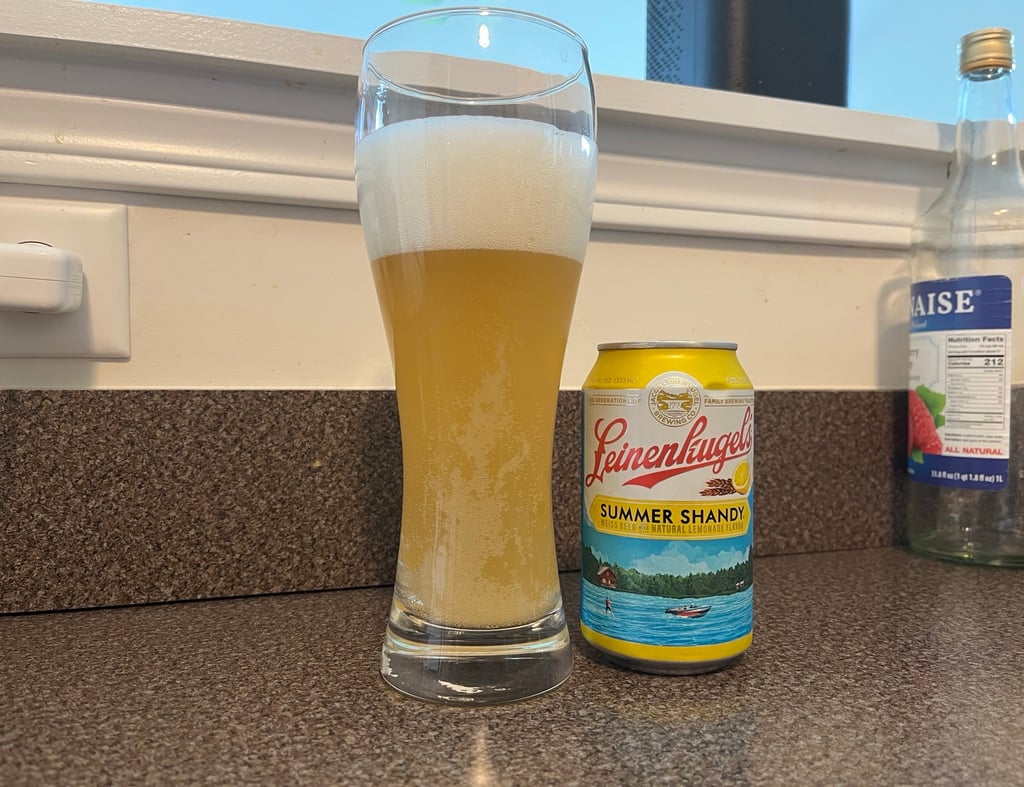
A weizen glass works especially well because its curved shape helps maintain the beer’s fluffy white head while concentrating the lemon-citrus aromatics near the top of the glass. The narrow base and wider top also showcase the beer’s hazy golden appearance beautifully. A chilled glass enhances the beer’s thirst-quenching quality, especially during hot weather. Summer Shandy is best served between 38 and 42 degrees Fahrenheit. At colder temperatures, the lemonade character becomes especially crisp and sparkling, while slightly warmer serving temperatures allow more wheat sweetness and honey nuances to emerge.
The Pour
Summer Shandy pours a cloudy pale gold with a bright white foamy head that dissipates gradually into fine lacing. The haze comes from the wheat beer base and contributes to its rustic, unfiltered appearance. Tiny streams of carbonation continuously rise through the glass, reinforcing the beer’s refreshing personality. In direct sunlight, the beer practically glows with a radiant lemon-gold hue that visually evokes summer afternoons, lakeside docks, and backyard barbecues.
The aroma
Is immediately citrus-driven. Fresh lemon zest dominates the nose, followed by sweet lemonade notes, hints of wheat bread, mild honey sweetness, and subtle floral undertones from the hops. There is very little alcohol presence, which enhances the beer’s easygoing appeal. The aroma is intentionally inviting even to people who normally do not enjoy beer, and this accessibility became one of the product’s greatest strengths. Some beer enthusiasts criticize the lemonade character as bordering on soft-drink sweetness, while others celebrate precisely that quality because it makes the beer exceptionally approachable. Community reactions online often note that Summer Shandy serves as a gateway beer for newer drinkers or those who dislike bitter lagers and IPAs.
On The Palate
The first impression is bright lemon citrus followed by gentle wheat malt sweetness. The carbonation is lively and crisp, creating a highly refreshing mouthfeel. Mid-palate flavors reveal notes of lemonade concentrate, subtle honey, light cracker malt, and a whisper of herbal hop bitterness. Because the bitterness remains extremely low, the finish stays smooth and lightly sweet rather than drying or resinous. The beer’s low ABV contributes to its easy-drinking personality and makes it ideal for outdoor social settings. Unlike heavier wheat ales or aggressively tart citrus beers, Summer Shandy remains balanced enough for multiple servings without overwhelming the palate.
The Finish
The overall experience of Summer Shandy is rooted in refreshment rather than complexity. Beer purists searching for intricate malt layering, barrel aging, or aggressive hop experimentation may find it simplistic. Yet that simplicity is precisely why the beer became such a massive commercial success. It captures a nostalgic sensory profile: warm weather, grilled food, lawn chairs, baseball games, and relaxed afternoons. Few beers so completely align their flavor identity with a specific season. Summer Shandy essentially became synonymous with summer drinking culture in many parts of the United States. Reddit discussions and beer forums frequently reference how ubiquitous the beer became nationwide, with many consumers associating the Leinenkugel’s brand almost entirely with its shandy lineup.
Nutritional Information:
A standard 12-ounce serving contains approximately
· *Calories 136–166
· *Carbohydrates 12.5 to 16.4 grams
· *Protein 1.3–1.4 grams
· Alcohol by volume is 4.2%
· IBUs 11
* Our research did not yield direct specifics and we made estimations based on beers of a similar style.
Casual Dining:
· Grilled chicken sandwiches
· Fish tacos
· Summer salads
· Barbecue chicken
· Pizza
· Shrimp skewers
Meals:
· Grilled meats
· Grilled salmon
· Fried cod
· Crab cakes
· Shrimp boils.
Cheese pairings:
· Goat cheese
· Brie
· Havart
· Fresh mozzarella
· Gouda
All harmonize with the beer’s citrus sweetness. The acidity of the lemonade character also complements tangy cheeses without overwhelming them. Sharp aged cheddars can work, though they may dominate the delicate wheat profile.
Dessert pairings:
· Citrus sweetness
· Lemon bars
· Key lime pie
· Vanilla bean cheesecake
· Berry shortcake
· Angel food cake
· Fruit tarts
All make excellent companions. The beer’s carbonation and citrus brightness help cleanse the palate after rich desserts while reinforcing fruit-forward flavors.
As an overall evaluation, Summer Shandy succeeds brilliantly within its intended purpose. It is not attempting to be an experimental Belgian farmhouse ale, a double dry-hopped IPA, or a barrel-aged imperial stout. Instead, it delivers exactly what it promises: a highly refreshing, citrus-forward summer beer with broad appeal and dependable drinkability. Its balance of wheat beer softness and lemonade brightness helped redefine the American summer seasonal category and opened craft-adjacent beer drinking to many consumers who otherwise avoided traditional beer bitterness.
Final Score: 87 / 100
Summer Shandy earns high marks for drinkability, refreshment, seasonal identity, accessibility, and consistency. While seasoned craft enthusiasts may desire more complexity or natural citrus depth, few beers have ever captured the essence of summertime relaxation as effectively or as commercially successfully as Leinenkugel’s Summer Shandy.