beerreviewsandmore.com
Staropolskie Miodne / Honey Beer
An Imported Polish Honey Lager
IMPORTED BEER
Vince Kozlo
5/11/20265 min read
The Kultowy Browar Staropolski (Brewery)
The story of Kultowy Browar Staropolski is deeply tied to the industrial and cultural history of central Poland. The brewery traces its roots back to 1892 in the city of Zduńska Wola, where it was founded during a period when regional breweries flourished throughout Eastern Europe. In its earliest years, the brewery focused on traditional Polish lagers and local farmhouse-inspired recipes that reflected the tastes of working-class communities and rural taverns alike. Unlike many mass-production breweries that later industrialized aggressively, Browar Staropolski maintained an attachment to older brewing methods, especially open fermentation and long lagering times. The brewery endured wars, political upheaval, communist-era restructuring, and economic instability before production was eventually revitalized in 2014 by new ownership under Dystrybucja Pomorze, which restored the facility and emphasized nineteenth-century brewing traditions once again.
One of the defining aspects of the brewery’s modern identity is its emphasis on traditional craftsmanship and employee-centered production culture. Browar Staropolski promotes slower brewing schedules, natural ingredients, and open fermentation methods that require more manual oversight than automated industrial brewing systems. Employees are trained in heritage brewing techniques rather than purely mechanized processes, creating a workplace culture built around preserving historical brewing knowledge. The brewery frequently highlights that its beers may ferment and mature for up to 180 days, a process requiring patience, technical skill, and consistent cellar management. This philosophy reflects a broader European craft-brewing movement that values artisanal labor over rapid throughput production.
Environmental stewardship also forms an important part of the brewery’s identity. Browar Staropolski emphasizes the use of natural ingredients without artificial acceleration methods, and its brewing philosophy centers around minimal intervention and traditional fermentation practices. Open fermentation and extended conditioning naturally reduce reliance on certain industrial processing shortcuts. The brewery also markets itself as a guardian of Polish brewing heritage, connecting sustainability not only to environmental responsibility but also to cultural preservation. Today, the brewery remains under the ownership of Dystrybucja Pomorze, the company credited with rescuing and revitalizing the historic facility in 2014. The brewery’s restoration has allowed classic Polish honey beers and lagers to return to international markets, particularly throughout Europe and parts of the United States.
The Beer
Among the brewery’s most distinctive creations is Staropolskie Miodne / Honey Beer, sometimes marketed simply as Staropolskie Honey Beer. The beer itself is rooted in centuries-old Polish traditions that blended brewing and mead-making. Poland has one of Europe’s oldest mead cultures, and this beer essentially bridges the worlds of lager and mead into something resembling a modern braggot-style honey lager. The current version became widely recognized around 2017 when the brewery renamed the beer from “Staropolskie Podwójnie Miodowe” to “Staropolskie Miodne.” However, the recipe itself predates the rebranding and was designed to revive old Polish honey brewing traditions.
Style
A fascinating space between a honey lager and a braggot.
Official beer databases often classify it as a braggot because of the heavy honey influence, though the brewery itself markets it as a honey beer or honey lager. At 4.7% ABV, it is relatively approachable and designed more for flavor complexity than sheer strength. Unlike stronger Scandinavian honey ales or heavy mead hybrids, Staropolskie Honey Beer remains drinkable and session-friendly while still delivering a pronounced honey character.
Malt bill
· Pilsner malt
Which provides a clean grain backbone that allows the honey character to remain the centerpiece. Pilsner malt contributes light cracker-like notes, soft bread crust flavors, and a crisp lager foundation. Because honey can easily dominate a beer’s flavor profile, the restrained use of specialty malts keeps the beer from becoming heavy or syrupy.
Hops profile
· Magnum
· Hallertauer Tradition
Magnum provides smooth, restrained bitterness without aggressive herbal sharpness, while Hallertauer Tradition contributes subtle floral and grassy noble-hop aromatics. These hops are not intended to dominate the palate. Instead, they serve as balancing agents that keep the sweetness from becoming cloying. The resulting bitterness level is very low to moderate, likely sitting around 10–15 IBUs, though official IBU figures are not consistently published.
Appropriate Glassware
for Staropolskie Honey Beer is a tulip glass or a stemmed goblet.
Why
A tulip glass is particularly effective because it concentrates the floral honey aromatics near the rim while supporting the beer’s moderate carbonation and soft head retention. The inward curve of the glass enhances aroma delivery, which is crucial for a honey-forward beer where scent contributes heavily to the drinking experience. A stemmed vessel also prevents hand warmth from rapidly affecting serving temperature. Honey beers benefit from slightly warmer serving temperatures than standard lagers because colder temperatures suppress aromatic complexity.
Serving Temperature
Ideally between 50–55°F (10–13°C). At this range, the honey aromatics become more expressive while the lager base still remains crisp and refreshing. If served too cold, the beer can taste overly sweet and muted. If served too warm, the honey sugars may become sticky and overly dominant.
Pour
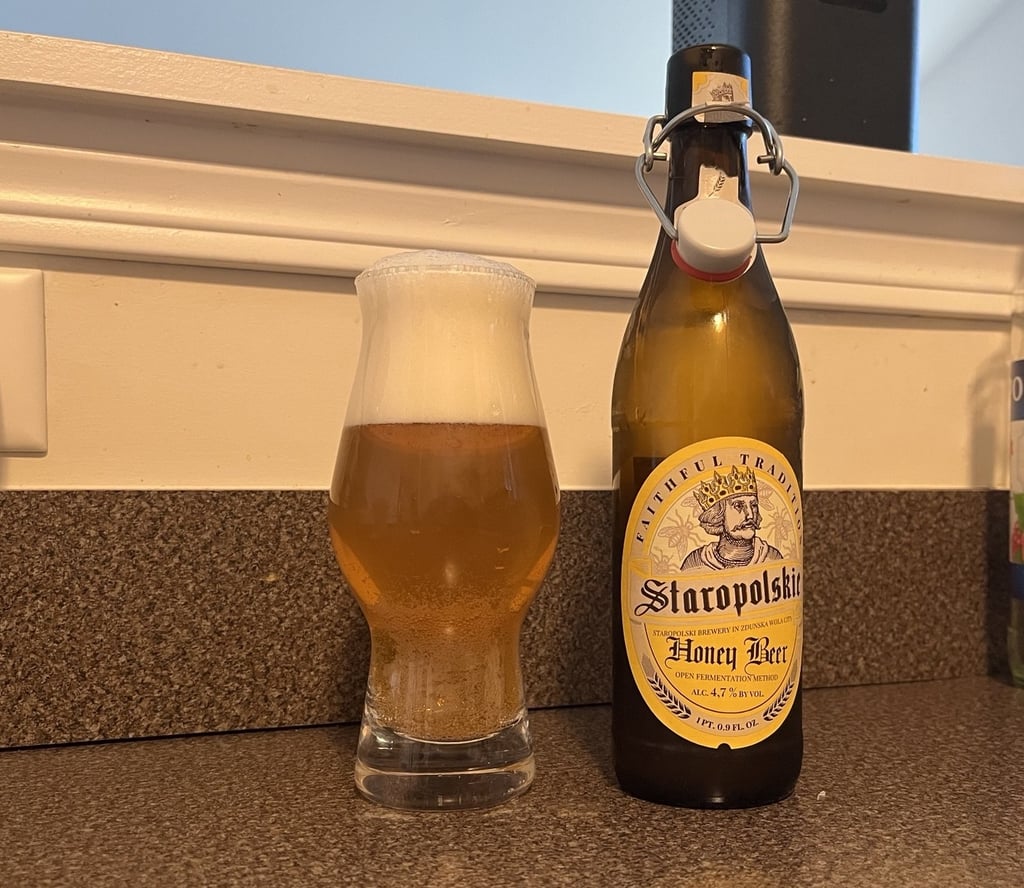
Visually, the beer pours a bright golden amber to honey-gold color with excellent clarity. A modest white foam cap forms initially before settling into a thin collar around the glass. Carbonation is lively enough to maintain visual elegance without becoming aggressive. In proper lighting, the beer carries a glowing amber hue reminiscent of wildflower honey or polished amber resin. The appearance immediately signals sweetness and warmth before the first sip even reaches the palate.
Aroma
This is where Staropolskie Honey Beer truly distinguishes itself. The nose opens with rich honeycomb, floral nectar, fresh bread crust, and hints of biscuit malt. Beneath the sweetness lies a delicate grassy herbal note from the Hallertauer Tradition hops. There are also faint mead-like aromatics that evoke wildflowers and warmed beeswax. Unlike aggressively sweet honey ales, the aroma retains balance and never becomes syrupy. Instead, it feels rustic, old-world, and inviting.
Tasting Notes
Begins with immediate honey sweetness that spreads across the tongue in soft waves rather than sharp sugary bursts. Mid-palate flavors reveal toasted bread, cereal grain, and light herbal spice. The honey character is authentic and natural tasting rather than artificial or candy-like. There is minimal bitterness, but just enough hop structure to maintain drinkability. As the beer warms slightly, the mead-like qualities become increasingly noticeable, adding floral complexity and a silky mouthfeel. The finish is semi-sweet, smooth, and lingering, with traces of honeycomb and warm grain remaining after each sip.
Mouthfeel
Medium-bodied with gentle carbonation and a soft texture. The beer has a slight stickiness from the honey content, though it stops short of becoming heavy. Open fermentation contributes subtle ester complexity that adds depth without overwhelming the lager structure. The overall experience feels both historical and comforting, almost like drinking a hybrid of beer and traditional Polish mead. It is less about sharp refreshment and more about slow appreciation. This is the kind of beer best enjoyed during cooler evenings, autumn meals, or relaxed social gatherings where conversation and sipping take precedence over rapid consumption.
Nutritional values are not officially published by the brewery, but based on style, ABV, and comparable honey lagers, a 500 ml bottle typically contains approximately:
Calories: 230
Carbohydrates: 15–20g
Protein: 1–2g
Alcohol by Volume (ABV): 4.7%
International Bitterness Units (IBUs): Estimated 10–15
Food pairing opportunities with Staropolskie Honey Beer are extensive because the beer balances sweetness, grain, and floral character so effectively.
For hearty dishes, it pairs beautifully with:
· Roast duck with honey glaze
· Kielbasa and grilled sausages
· Pork schnitzel
· Roast chicken with herbs
· Smoked ham
· Honey-glazed salmon
For casual dining:
· Soft pretzels with mustard
· Flatbread pizzas
· Chicken sandwiches
· Polish pierogi
· Fried chicken
· Charcuterie boards
Cheese pairings work especially well because the honey sweetness complements salt and creaminess:
· Brie
· Camembert
· Gouda
· Havarti
· Mild blue cheese
· Smoked cheddar
Dessert pairings are arguably where this beer shines brightest:
· Baklava
· Honey cake
· Apple strudel
· Cheesecake
· Bread pudding
· Vanilla bean ice cream
· Crème brûlée
As a complete package, Staropolskie Honey Beer succeeds not because it is trendy or extreme, but because it delivers authenticity and historical character. It respects Polish brewing traditions while offering something genuinely different from mainstream lagers and heavily hopped craft beers. The beer may not appeal to drinkers seeking aggressive bitterness or dry finishes, but for those who appreciate honey complexity, malt softness, and old-world brewing character, it offers a memorable experience.
Overall Score: 89 / 100
Strengths:
· Authentic honey character
· Strong historical identity
· Excellent aroma complexity
· Smooth drinkability
· Unique crossover between lager and mead traditions
Weaknesses:
· Sweetness may overwhelm hop-focused beer drinkers
· Limited bitterness reduces balance for some palates
· Less complexity than stronger traditional braggots
Ultimately, Staropolskie Honey Beer feels like a liquid tribute to old Polish brewing culture — rustic, warming, floral, and deeply rooted in tradition rather than modern brewing trends.