beerreviewsandmore.com
Backwoods Bastard
Barrel-Aged Scotch Ale or Wee Heavy by Founders Brewery
DOMESTIC BEER
Vince Kozlo
5/9/20265 min read
Founded in 1997 in Grand Rapids
Founders Brewing Company emerged from humble beginnings and near financial collapse to become one of the most recognizable names in American craft brewing. Created by homebrewers Mike Stevens and Dave Engbers, the brewery initially struggled to gain traction in a crowded beer market dominated by lighter lagers and safer flavor profiles. According to the brewery’s own history, the turning point came when the founders stopped trying to make beer for everyone and instead brewed bold, flavor-driven beers they themselves wanted to drink. That philosophy led to iconic releases such as Dirty Bastard, KBS, and eventually Backwoods Bastard. Over the years, Founders became known for helping pioneer the American bourbon barrel-aging movement and earned global acclaim for producing aggressive, unapologetically rich ales and stouts. The brewery’s rise from a struggling local operation into one of the nation’s largest craft breweries is a story of persistence, creativity, and risk-taking. A comprehensive review of the brewery itself is available under the “Centennial Beer Review.”
The Beer
Among the brewery’s most celebrated creations is Backwoods Bastard, a beer that has developed something close to a cult following among craft beer enthusiasts. First introduced in the mid-2000s as a barrel-aged evolution of Founders’ already beloved Dirty Bastard Scotch Ale, Backwoods Bastard was conceived as an experiment in taking traditional Scotch ale richness and layering it with the deep complexities of bourbon barrel maturation. The result was a beer that blurred stylistic boundaries. It retained the heavy malt-forward backbone of a classic Scottish Wee Heavy while embracing the vanilla, oak, char, and whiskey warmth that bourbon barrels impart. Over time, it became one of Founders’ flagship barrel-aged offerings and helped cement the brewery’s reputation as a master of spirit barrel maturation.
Style
Backwoods Bastard is classified as a barrel-aged Scotch Ale or Wee Heavy.
Malts:
Abbey malts
Crystal malts
Hops:
Nugget
Willamette hops
Tpgether, they provide balancing bitterness and subtle earthy complexity. These ingredients are carefully chosen to create depth rather than aggressive hop dominance. The Crystal malts contribute layers of caramel, burnt sugar, and toffee, while the Abbey malts lend dark fruit characteristics reminiscent of figs and raisins. The Nugget hops offer a firm bitterness necessary to prevent the beer from becoming cloying, while Willamette hops add mild spice and herbal undertones. Every component exists in service of balance. This is not a beer attempting to overwhelm with one-dimensional bourbon intensity; instead, it seeks harmony between malt sweetness, oak influence, alcohol warmth, and restrained hop bitterness.
Appropriate Glassware
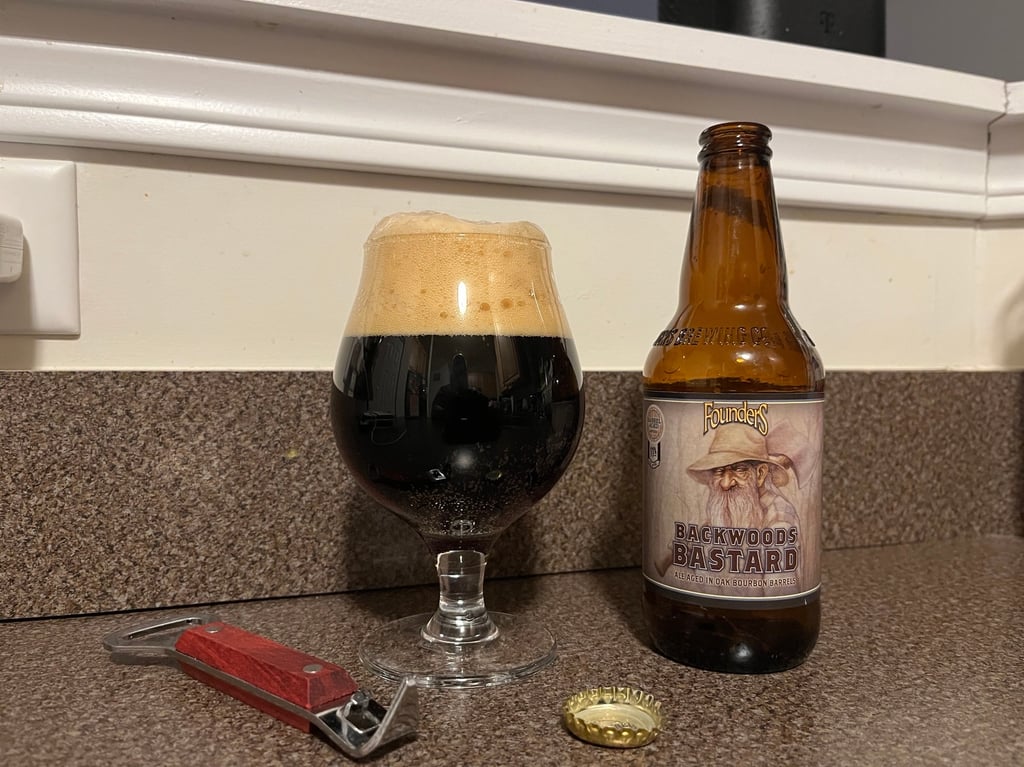
The ideal vessel for consuming Backwoods Bastard is a tulip glass or snifter.
Why
These styles of glassware are specifically designed to enhance aromatic concentration and encourage slow sipping. Given the beer’s elevated alcohol content and layered aroma profile, proper glassware becomes essential to appreciating the experience fully. A tulip glass narrows at the top, funneling the aromas upward while allowing sufficient room for swirling. This movement awakens volatile compounds hidden within the beer, intensifying notes of bourbon, vanilla, dark fruit, and roasted malt. Drinking Backwoods Bastard from a standard pint glass would significantly diminish its aromatic complexity and rob the drinker of much of the sensory experience that makes the beer exceptional. Because this is a contemplative beer rather than a thirst-quenching lager, presentation matters.
Serving temperature
Backwoods Bastard performs best when served between 50 and 55 degrees Fahrenheit. Serving it too cold suppresses its malt complexity and hides the nuanced bourbon barrel notes beneath alcohol sharpness. As the beer gradually warms in the glass, flavors unfold in waves. Initial sweetness transitions into oak spice, then dark fruit richness, followed by lingering whiskey warmth. It is a beer that evolves over the course of a single pour, rewarding patience and slow consumption.
The Pour
It pours with the dense malt richness expected of the style but elevates the experience through bourbon barrel aging. Visually, Backwoods Bastard is striking. It pours a deep mahogany brown with ruby highlights visible under strong light. The head is creamy tan, initially thick and persistent before settling into a delicate ring around the glass. Carbonation appears restrained, appropriate for the style, with slow-moving streams of bubbles rising beneath the surface. There is an undeniable heaviness to its appearance. The beer coats the glass with sticky lacing and oily legs, immediately hinting at its substantial body and elevated alcohol content. Even before the first sip, it communicates richness and intensity.
Aroma
Here’s where Backwoods Bastard truly begins to separate itself from ordinary Scotch ales. The nose opens with immediate bourbon character — vanilla, charred oak, caramelized sugar, and whiskey warmth rise from the glass. Beneath that initial wave lies an intricate malt profile featuring molasses, toasted bread crust, dark fruit, brown sugar, and faint smoke. Subtle leather, tobacco, or earthy spice notes. As the beer warms, the bouquet becomes increasingly expressive. There is an almost dessert-like quality to the aroma, yet it never crosses into artificial sweetness. The bourbon barrels contribute sophistication rather than gimmickry. Founders itself describes aromas of caramel, vanilla, spice, dark fruit, and roasted malt, and those descriptors accurately capture the beer’s layered aromatic identity.
Taste
The flavor profile is expansive and remarkably cohesive. The first sip introduces sweet caramel, toffee, and brown sugar before quickly transitioning into oak, bourbon, and smoky malt. Mid-palate flavors include raisin, fig, molasses, and toasted nuts. There is a subtle earthy bitterness from the hops that prevents the sweetness from becoming overwhelming. The alcohol presence is undeniable yet integrated smoothly into the body of the beer rather than presenting as harsh ethanol burn. One of Backwoods Bastard’s greatest strengths is its balance. Many barrel-aged beers become dominated by bourbon character, but this beer remains unmistakably rooted in Scotch ale tradition. The bourbon barrels amplify the experience without erasing the beer’s malt-driven identity.
Mouthfeel
Is thick, velvety, and warming. It coats the palate with rich sweetness before finishing semi-dry with lingering oak spice and whiskey heat. Despite its 11% ABV, it avoids becoming syrupy or exhausting. Instead, it encourages slow sipping and reflection. This is a fireside beer — contemplative, comforting, and immersive. It is the type of beer that transforms ordinary drinking into ritual. Many craft beer enthusiasts consider it one of the finest examples of a barrel-aged Scotch ale available in the American market. On Reddit and beer enthusiast forums, drinkers frequently praise its aging potential, with some claiming it becomes smoother and more rounded after several years in cellar conditions. Others describe it as one of the definitive examples of barrel-aging done correctly.
Nutritional Information
Based on 12 Oz Serving:
Calories: 320–350
Carbohydrates 25–30 grams
Protein 2–3 grams.
ABV 11%
IBU 50
Food pairings
Hearty dishes:
Smoked brisket
Braised short ribs
Venison stew
Roasted duck
Casual dining:
Gourmet burgers
Bacon-heavy dishes
Barbecue ribs
Sharp pub-style fare
Cheese:
Aged cheddar
Smoked gouda
Blue cheese
Stilton
Nutty alpine cheeses
Dessert pairings:
Bread pudding with bourbon sauce
Pecan pieC
Crème brûléeS
Sticky toffee pudding
Dark chocolate cake
Maple-glazed pastries
All harmonize naturally with Backwoods Bastard’s flavor profile. Vanilla bean ice cream paired with a small pour of the beer can become a surprisingly luxurious experience, creating something akin to an adult bourbon float. The beer’s dessert-like qualities make it particularly suited to winter evenings, holiday gatherings, and after-dinner sipping.
Overall, Backwoods Bastard remains one of the defining barrel-aged ales of the American craft beer movement. It is bold without being reckless, sweet without becoming cloying, and complex without sacrificing drinkability. Its ability to merge traditional Scotch ale characteristics with bourbon barrel sophistication is genuinely impressive. More than simply a strong beer, it is a layered sensory experience that rewards attention and patience. While casual drinkers may find its intensity overwhelming, enthusiasts of malt-forward, barrel-aged beers will likely consider it exceptional.
Final Score: 96/100
Backwoods Bastard succeeds not only as a beer, but as an example of what modern craft brewing can achieve when tradition, experimentation, and patience intersect.